
California’s New Food Labeling Law Bans “Sell By” Dates to Cut Confusion and Food Waste
California’s New Food Labeling Law Bans “Sell By” Dates to Cut Confusion and Food Waste
At the home of Kimberley Kausen, a jug of milk past its printed “sell by” date sparks wildly different reactions among her family members. For her daughter, that date means the milk belongs straight in the trash. Her husband, by contrast, sees it as proof the milk is still perfectly good to use for several more days.
Kausen, a professional chef and cooking teacher based in Irvine, California, takes a more deliberate approach, often relying on her sense of smell to judge the milk before making a decision. “I put real thought into it,” she said. “When it comes to meat and poultry, I’m extremely cautious — I always do both a smell test and a touch test before deciding what to do.”
This small kitchen debate playing out in Kausen’s home is mirrored in households across California and the entire U.S. For decades, inconsistent, vague phrasing on food packaging has left shoppers guessing: Is this food just past its peak quality, or is it actually unsafe to eat? Starting Wednesday, California is aiming to reduce both this confusion and the unnecessary food waste it creates (when consumers throw out perfectly good food early) with a new mandatory food labeling law.
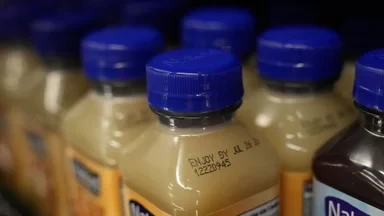
The regulation bans the use of “sell by” labels on all food packaging. Experts have long clarified that “sell by” dates only serve as a guide for retailers to know how long to display products on shelves, and they are never an indicator of whether the food inside is safe to consume.
Going forward, any manufacturer selling food in California must use one of two standardized label options: “Best if Used By” for dates that mark when a product is at its peak quality, and “Use By” for dates tied to food safety. According to Democratic Assemblymember Jacqui Irwin, the author of the bill, manufacturers may choose to use either label or both, depending on the product.
When California approved the law in 2024, it became the first U.S. state to mandate standardized food date labeling, with dual goals of cutting food waste and reducing the state’s climate-warming greenhouse gas emissions. New York state lawmakers recently passed a nearly identical bill, which is now awaiting Governor Kathy Hochul’s signature. Similar labeling reform legislation has also been introduced in Illinois, Maryland, Massachusetts, New Jersey, and South Carolina, though it has not yet passed in those states.
Nick Lapis, advocacy director for Californians Against Waste (a group that co-sponsored the bill), says confusing date labels are the top cause of household food waste. He adds that “sell by” dates have also created problems for California food banks, because most people assume those dates mean the food has already expired.
“We don’t need to build huge new infrastructure or spend tons of money to solve this problem,” Lapis said. “We just need companies across all brands to use the same consistent language.”
A 2022 food waste report from the University of Maryland found there are more than 50 different types of date labels used on packaged food sold in U.S. stores. Most date labeling is largely unregulated, and the dates printed rarely relate to actual food safety.
“Consumers get confused, so they default to assuming any date on the package means ‘don’t eat this, throw it away,’” said Kumar Chandran, policy director at ReFED, a nonprofit focused on reducing food waste. Chandran added that the passage of labeling reform in California and New York has given major momentum to the push for a national national labeling standard. A bipartisan bill that would establish uniform federal food labeling rules is currently pending in Congress.
The U.S. Department of Agriculture first recommended more than a decade ago that food sellers switch to “Best if Used By” labeling. Currently, infant formula is the only food product with federally regulated date labeling requirements in the U.S.
With no federal rules dictating what information date labels must include, inconsistent labeling has led to widespread consumer confusion — and accounts for nearly 20% of all food waste in the country, according to the U.S. Food and Drug Administration. In California alone, that adds up to roughly 6 million tons of unexpired, perfectly safe food thrown into landfills every year.
Nate Rose, a spokesperson for the California Grocers Association, noted that many grocers have had to overhaul their existing labeling systems to comply with the new rule, but the association as a whole supports the change. The new labels will create “a win-win where we can reduce food waste and consumers will find these decisions a little bit simpler,” he said. Rose added that shoppers will still see old pre-law labels on store shelves for months to come, as grocers sell through existing inventory printed before the regulation took effect.